

Partnership is the Platform: What Booker T. Washington and Julius Rosenwald Teach Us About Scaling Education
There’s a version of educational innovation that talks a lot about technology, platforms, and disruption.
And then there’s the version that actually works.
If you study the partnership between Booker T. Washington and Julius Rosenwald, you’ll find something deeper than philanthropy—you’ll find a model for scale.
Nearly 5,000 schools.
Built across the South.
Not by mandate.
Not by chance.
But through a shared vision between an educator and a partner who believed in that vision enough to help scale it.
That’s not just history. That’s a blueprint.
Why This Still Matters
At Legacy Collective, we think a lot about scale.
Not scale as in “more users.”
Scale as in: How do we expand access to knowledge, opportunity, and ownership in a way that actually lasts?
What Booker T. Washington understood—and what Rosenwald respected—was this:
Education only works at scale when it is rooted in the lived realities of the people it serves.
Washington wasn’t just building schools.
He was designing an educational philosophy grounded in self-sufficiency, skill development, and community empowerment.
Rosenwald didn’t invent that vision.
He invested in it.
The Real Innovation: Alignment Between Vision and Capital
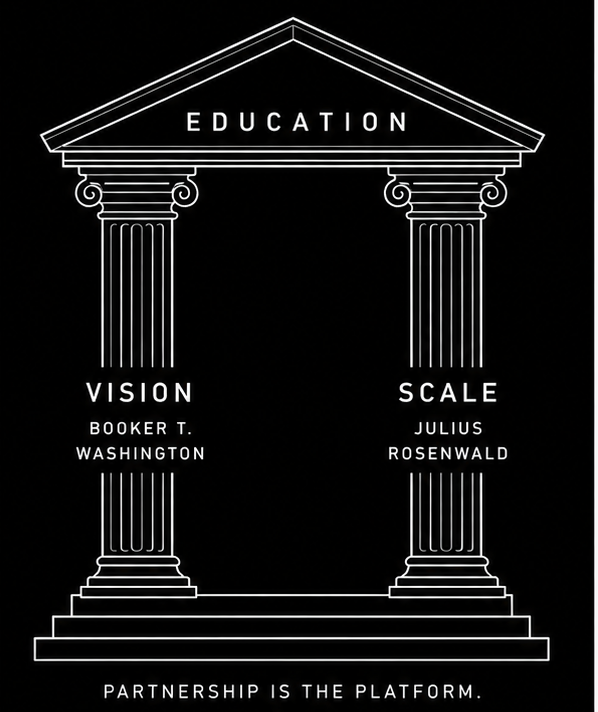
The Rosenwald Schools succeeded because two roles were clearly defined—and equally important:
Booker T. Washington brought the educational model
Julius Rosenwald brought the capital and commitment to scale it
But neither worked without the other.
Washington understood:
What needed to be taught
How communities learn
Why ownership matters
Rosenwald understood:
How to resource the vision
How to structure giving for accountability
How to scale without losing integrity
That alignment is rare.
And it’s exactly what made the model work.
The Piece That Made It Scalable
Here’s the part most people miss:
Washington’s approach required communities to engage in the process of building their own schools.
Rosenwald reinforced that requirement through his funding model.
Which meant:
Communities contributed land, labor, or money
Educators shaped the learning experience
Funding accelerated—not replaced—local ownership
This wasn’t charity.
This was co-creation at scale.
What This Means for Today’s Learning Economy
We’re in a moment where everyone is talking about:
Micro-credentials
Alternative education pathways
Creator-led learning
Workforce readiness
But most models separate the roles that Washington and Rosenwald kept aligned.
We often see:
Educators without infrastructure
Platforms without educational depth
Funding without community connection
And when those pieces are disconnected, scale breaks.
Rebuilding That Alignment Today
At Legacy Collective, we think about this partnership model all the time.
Because in many ways, we’re trying to recreate that alignment in a modern context.
The Educator (Booker T. Washington’s Role)
The expert, the storyteller, the practitioner.
The person who understands:
The content
The learner
The cultural context
This is where real value lives.
The Platform & Partnership Layer (Rosenwald’s Role)
The infrastructure that helps that knowledge scale.
This includes:
Course creation systems
Credentialing frameworks
Distribution channels
Strategic partnerships
Not to replace the educator—but to amplify them.
The Community (The Constant)
Still the most important part.
Learning works best when people:
See themselves in it
Contribute to it
Benefit from it
That hasn’t changed.
From Industrial-Era Schools to Digital Learning Ecosystems
What Washington and Rosenwald built physically, we now have the opportunity to build digitally.
But the principle remains the same:
Scale happens when educational vision and enabling infrastructure move together.
Not separately.
Not sequentially.
Together.
The Possibility in Front of Us
If we get this right, we’re not just building courses.
We’re building systems where:
Educators can structure and credential their knowledge
Partners can support and scale that knowledge
Communities can access, contribute to, and benefit from it
That’s the real opportunity.
A Call to Build in Partnership
The lesson isn’t just that Rosenwald gave.
And it’s not just that Washington taught.
It’s that they built something together that neither could have built alone.
That’s the model.
And if we’re serious about scaling education today, we should be asking:
Who holds the vision?
Who enables the scale?
And how do we align them intentionally?
Because the future of learning won’t be built by one side of that equation.
It will be built in partnership.
